Walk through most farming communities in southwest or north-central Nigeria between November and March and you will find the same thing: cleared land sitting empty, farm workers gone back to their villages or looking for casual work elsewhere, and investors waiting for the rains to return before any production activity resumes. This pattern is so widespread that many people in the Nigerian agricultural space treat it as natural, an unavoidable feature of tropical farming that cannot be changed.
It is not. The dry season in Nigeria, which runs from approximately November to March across most of the south and lasts even longer in the north, is a period when solar radiation is high, temperatures are warm, and the soil retains residual moisture from the rainy season for longer than most farmers utilise. With the right water source, the right crop selection, and the right management approach, the dry season is not a gap in the production calendar. It is a second production window that the majority of Nigerian farms are currently leaving empty.
This article covers the crops that perform well in dry season production, the water sources and irrigation approaches that make it viable, the specific management adjustments that dry season farming requires compared to wet season production, and the financial case for adding a dry season cycle to a farm that currently operates for only half the year.
“A farm that produces for six months and sits idle for six months is not a farm operating at capacity. It is a farm operating at half capacity. The dry season is not downtime. It is opportunity.”
Why Most Nigerian Farms Stop in the Dry Season
The primary reason most Nigerian farms stop during the dry season is the absence of a reliable water source beyond rainfall. When the rains stop, the soil dries out within weeks, and crops planted in dry conditions without supplemental water cannot establish or survive. Without water management infrastructure, dry season farming is simply not possible for most crops, and the default response has been to wait for the next rainy season rather than to invest in the infrastructure that would make year-round production viable.
A second reason is the harmattan wind, which blows from the Sahara Desert across Nigeria between November and February, bringing dry, dusty air that increases evapotranspiration rates significantly. Crops under harmattan conditions lose water from leaves and soil faster than in the rainy season, which means irrigation requirements are higher and the consequences of any irrigation gap are more severe. Managing this effectively requires a more attentive and consistent irrigation schedule than many farm operations are set up to deliver.
The third reason is simply inertia and habit. Farmers and farm managers who have always planted with the rains and rested in the dry season often continue doing so not because it is the best approach but because it is the familiar one. The transition to year-round production requires upfront capital investment in water infrastructure, a different crop and management plan for the dry cycle, and a willingness to do something that most farms in the area are not doing. All of these require deliberate decision-making rather than routine repetition of the annual pattern.
Crops That Perform Well in Dry Season Production
Not every crop is suited to dry season production in Nigeria. The crops that work best in the dry season share certain characteristics: they are relatively fast-maturing, they have high market value that justifies the additional cost of irrigation, and they either tolerate or actually prefer the lower humidity and higher solar radiation of the dry season period.
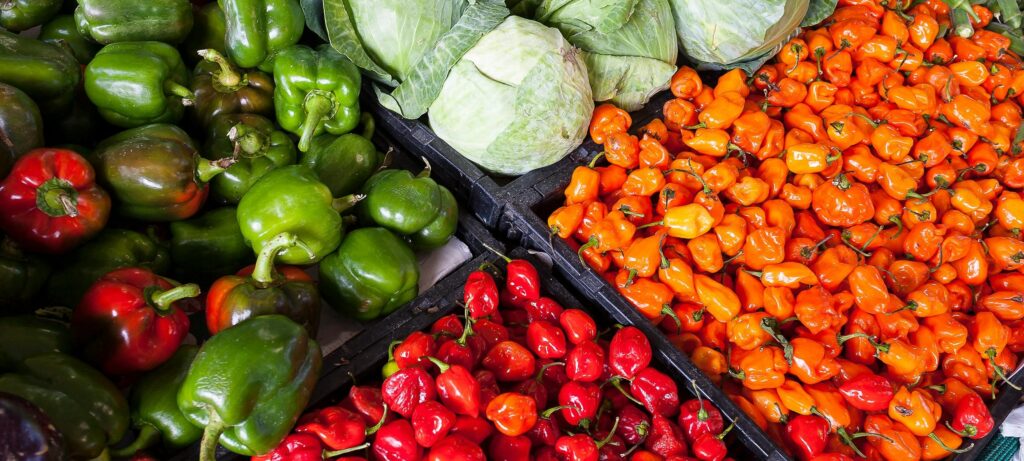
Tomatoes are one of the most commercially attractive dry season crops in Nigeria. Tomato prices reach their peak between January and April, precisely during the dry season when field-grown rainy season tomatoes are not available and supply from the Kano and Kaduna producing areas is reduced. A well-irrigated dry season tomato plot in Ogun, Oyo, or Lagos State can achieve prices two to three times higher than the same crop harvested during the wet season flush, which more than compensates for the additional water and management cost of dry season production.
Leafy vegetables including waterleaf, fluted pumpkin known as ugu, amaranth, and various types of spinach are among the best dry season crops for urban and peri-urban farms. Their short maturity period of four to eight weeks allows multiple harvests within a single dry season, and urban consumer demand for fresh vegetables does not stop during the dry season. Farms within 30 kilometres of a major city that can produce fresh leafy vegetables from January to March are accessing a market with consistently strong prices and reliable buyer demand.
Pepper, both fresh and dried, is another strong dry season crop. Dried pepper commands premium prices when fresh rainy season supply has ended, and the dry, sunny conditions of the harmattan period are actually ideal for natural sun-drying of harvested pepper. Onions, which require a period of low humidity for curing and have a long shelf life once dried, are one of the classic dry season crops of northern Nigeria and are increasingly being produced in irrigated plots in the north-centre as well.
Catfish farming is one of the most attractive dry season income sources for farms that already have pond infrastructure from a wet season fish farming cycle. The fish ponds require water regardless of season, and with a reliable borehole or surface water source for pond management, a second catfish cycle can be run through the dry season with minimal additional infrastructure cost beyond what the wet season operation already requires. This makes fish farming one of the most capital-efficient dry season additions to an existing farm operation.
Water Sources for Dry Season Farming
The water source is the enabling infrastructure for any dry season farming operation. Without a reliable, adequate water supply, everything else in a dry season farming plan is theoretical. Understanding the options available, what each costs, and what volume each can supply is the practical starting point for any farm that is seriously considering year-round production.
Boreholes are the most common water source for dry season farming in southwest and north-central Nigeria. A standard motorised borehole in the southwest costs between ₦800,000 and ₦2,000,000 to drill and equip depending on depth, the aquifer conditions at the specific site, and whether solar-powered pumping is used or a generator-based pump. A well-sited and properly drilled borehole produces between 5,000 and 20,000 litres per hour depending on the aquifer yield, which is typically sufficient to irrigate between 0.5 and 2 hectares of vegetables or fruit crops with drip or sprinkler irrigation.
Surface water from rivers, streams, and farm dams is the most cost-effective water source where it is available. A river or perennial stream within 200 to 500 metres of a farm site can supply irrigation water with nothing more than a pump, a pipe system, and the management discipline to operate it consistently. The challenge with surface water in the dry season is that stream and river levels drop significantly in Nigeria between December and February, and some watercourses that appear reliable in the wet season run dry or too shallow for pumping by the middle of the dry season.
Farm ponds and small-scale dams, which capture and store rainwater during the wet season for use in the dry season, are a low-cost option for farms with the right topography and soil conditions to hold water. An earthen farm pond of 500 to 1,000 cubic metres capacity, constructed during the wet season when labour and equipment are less expensive, can provide sufficient stored water for a dry season vegetable production on 0.25 to 0.5 hectares. The limitation is volume. A single dry season on a larger farm with higher crop water demands will exhaust a small farm pond within weeks.
Irrigation Methods: Matching the System to the Crop and Scale
Having a water source is only the first part of dry season water management. Getting that water to the crops efficiently and at the right frequency is the operational challenge that determines whether the dry season production cycle is economical or not. Three irrigation methods are in common use on Nigerian small and medium farms, and the right choice depends on the crop type, the farm scale, the water source capacity, and the available budget for irrigation infrastructure.
Flood or furrow irrigation is the simplest and cheapest method. Water is applied to the base of crop rows through furrows or by flooding the entire bed, and gravity distributes it across the root zone. It requires no specialised equipment beyond a pump and delivery pipes, and any farm worker can operate it without training. The significant disadvantage is water use efficiency. Flood irrigation applies far more water than most crops need, a large proportion evaporates before reaching crop roots, and the wet soil surface between plants creates ideal conditions for weed germination. For large-scale grain crops it is a reasonable option, but for vegetables it is wasteful and can cause waterlogging that damages crop roots.
Sprinkler irrigation applies water as a fine spray above the crop canopy, simulating rainfall. It is more water-efficient than flood irrigation and can be used across a range of crop types including vegetables, groundnuts, and maize. The equipment cost for a basic sprinkler system covering one hectare runs between ₦200,000 and ₦500,000 depending on the sprinkler type and the pipe layout required. The main disadvantage is that wetting the leaves and canopy increases the risk of fungal disease, particularly in the relatively humid dry season conditions of the southwest.
Drip irrigation applies water directly to the root zone of each plant through a network of tubes and emitters, which is the most water-efficient method available. It reduces evaporation losses significantly, keeps the soil surface between plants dry which suppresses weed growth, and delivers water at a rate that the soil can absorb without runoff. For high-value vegetables like tomatoes and peppers, drip irrigation consistently produces better yields and lower post-harvest disease incidence than either flood or sprinkler methods. The equipment cost is higher, typically between ₦400,000 and ₦1,200,000 per hectare depending on the system quality and supplier, but the water savings and yield improvement typically justify the investment on commercial vegetable operations within one to two dry seasons.
Management Differences in Dry Season Farming
Dry season farming is not simply wet season farming with added water. The management requirements are different in several specific ways that a farm team accustomed to rainy season production needs to understand and adapt to before the dry season cycle begins.
Irrigation scheduling is the most critical management discipline in dry season production. Most vegetable crops need irrigation every one to three days during the dry season to maintain the soil moisture levels required for steady growth. Missing an irrigation cycle by even one day during the hottest part of the dry season can cause wilting and stress that sets back growth by a week or more and affects final yield. The irrigation schedule must be treated as a non-negotiable farm activity, not one that is fitted around other tasks or left to when someone gets to it.
Pest and disease pressure changes significantly in the dry season. Some rainy season pests are absent in the dry season while others, particularly aphids, whiteflies, and spider mites, thrive in the hot, dry conditions of harmattan. These sap-sucking insects can spread rapidly in dry season crops and cause both direct damage and the spread of viral diseases that reduce yield significantly. A dry season pest monitoring and management programme that is specifically designed for the conditions of the season is different from the wet season programme and should be planned before planting begins.
Weed management in dry season irrigated fields is a different challenge from wet season weeding. Irrigation water applied to the soil between crop rows stimulates weed germination just as effectively as rain does, and weeds that grow in irrigated conditions during the dry season can be just as competitive with crops as wet season weeds. Using mulch to cover the soil between crop rows significantly reduces this problem on vegetable plots and is one of the most practical management adjustments for dry season vegetable production. Drip irrigation, which keeps the inter-row soil dry while watering only the root zone of each plant, is the most effective structural solution to dry season weed management.
The Financial Case for Dry Season Production
The financial argument for adding a dry season production cycle is straightforward. A farm that currently produces one rainy season cycle per year and sits idle for the dry season has fixed costs, primarily land rent or mortgage, property taxes, basic security, and minimal maintenance, that continue throughout the idle period without generating any income to offset them. Adding a dry season cycle does not eliminate those fixed costs but it does generate revenue to offset them, and if the dry season crop is chosen and managed well, it generates a meaningful net profit on top of that.
Dry season vegetable prices in Nigeria are consistently higher than rainy season prices for the same crops. Tomatoes in February command two to three times the price they command in October at the peak of the rainy season harvest. Leafy vegetables maintain strong prices year-round but face less competition from other growers in the dry season because most open-field vegetable production in Nigeria follows the rainy season cycle. This price premium is the financial justification for the additional cost of irrigation infrastructure and the higher management intensity that dry season production requires.
The capital investment in irrigation infrastructure, primarily a borehole and a drip or sprinkler system, is a one-time expenditure that enables multiple dry season cycles over the life of the infrastructure. A borehole and drip irrigation system that costs ₦2 million to install and enables two hectares of dry season tomato production per year at a net margin of ₦800,000 per hectare pays back the infrastructure investment within two dry season cycles. From the third cycle onwards, the infrastructure cost is fully recovered and the dry season production contributes directly to farm profitability with no capital recovery burden.
How to Start: A Practical Entry Plan for Existing Farm Investors
If you currently have a managed farm that operates only during the rainy season, the transition to year-round production does not have to happen all at once. A phased approach that starts with a small dry season pilot, builds operational knowledge, and then scales up in subsequent years is the lower-risk way to add dry season production to an existing farm investment.
The first step is assessing whether the existing farm site has a viable water source for dry season production. If the site has a borehole already, assess whether its yield is sufficient for the scale of dry season production you are considering. If no borehole exists, commission a hydrogeological assessment to determine whether the site has an aquifer that can support one before committing the capital to drill. A hydrogeological assessment costs between ₦50,000 and ₦150,000 and takes two to three weeks. It is a small investment that eliminates the risk of drilling a borehole in a location where the aquifer is inadequate.
The second step is selecting the dry season crop based on the water source capacity, the market in the area around the farm, and the management team’s existing experience. Starting with a crop the management team already knows, even if it is not the highest-margin option, reduces the learning curve and the risk of the first dry season cycle significantly. A successful first dry season cycle at a smaller scale builds the operational confidence and the specific site knowledge to run a larger and more ambitious second cycle.
At Vantage Nigeria, we are actively expanding dry season production across our managed farm sites. Our Lanlate site in Oyo State and our Alabata site in Ogun State both have borehole access and are running dry season vegetable production in the current season. Investors in our managed farm programmes who want to add a dry season cycle to their existing farm investment should speak to our team about what is currently viable at their specific farm site.
The most common dry season farming failure is starting without a reliable water source confirmed. Farmers who begin preparing dry season beds before verifying that the borehole yield or surface water source is adequate for the full cycle consistently run short of water at the most critical growth stages, produce stressed crops that yield poorly and attract pest and disease pressure, and end up spending more on the failed cycle than they save by not investing in proper water infrastructure. Confirm the water first. Plant second.
Vantage Nigeria runs dry season production on our managed farm sites
If you have an existing farm investment with us and want to explore adding a dry season production cycle, talk to our operations team. We can assess your site’s water access, recommend the right crop and irrigation approach, and structure the additional investment to make the dry season cycle financially worthwhile. Reach us at vantagenigeria.com.
Want your farm producing income all year, not just half of it?
Talk to our team about dry season farming options, water source assessment, and how to add a second production cycle to your existing farm investment.
Book a Free Consultation